Market Review
Policy Support Strengthens. Risk Appetite Improves
A-shares rose early last week and then retreated, closing above the week’s opening level for the first time since the start of October. Media, electrical equipment, computers, and the agriculture sector were among the leaders. Declines were confined to communications stocks in the overseas computing and defensive sectors such as coal, oil and petrochemicals, and banking. Average daily turnover rose to RMB 1.85 trillion as risk appetite improved.
Net ETF inflows exceeded RMB 200 billion, up about RMB 100 billion from the previous week. On Tuesday, investors added roughly RMB 80 billion to positions in major broad-based ETFs.
Those purchases were consistent with the message from a November 6 State Council meeting, which called for stronger mechanisms to stabilize capital markets and greater stability within the stock market itself. The previous time the cabinet used an executive meeting to set out its stance on equities was during the U.S. tariff turmoil in April 2025. The renewed commitment reinforced the policy floor for A-shares.
The Democratic sweep affected asset prices through three channels. Tighter fiscal discipline could limit Treasury issuance and put downward pressure on U.S. Treasury yields. The prospect of limiting further escalation in geopolitical conflicts also pointed to lower oil prices. Anticipated changes in industrial policy and regulation favored new energy and healthcare but weighed on AI infrastructure. Against this backdrop, stocks in the overseas computing supply chain fell sharply, while new energy stocks rebounded strongly.
Market Outlook
Core indices offer exposure to a potential rebound
In the week ahead, we will watch U.S. inflation data after stronger-than-expected October nonfarm payrolls reinforced expectations of tighter monetary policy ahead. Post-election reports suggest the U.S., Israel and Iran show little sign of de-escalation, leaving oil prices uncertain. Once the market has priced in the initial effects of the midterms, we will watch for changes in policy and regulation and track hardware investment plans across the supply chain.
After weathering earnings pressures and the U.S. midterms, A-shares are gradually finding a floor as policy support takes hold. Core indices are our first choice, including the CSI 300, low-volatility dividend indices and the CSI 1000. We are watching healthcare, consumer and new energy closely (potential for a turnaround). In technology, we favor domestic substitution in semiconductors and themes related to technology applications over the overseas computing .
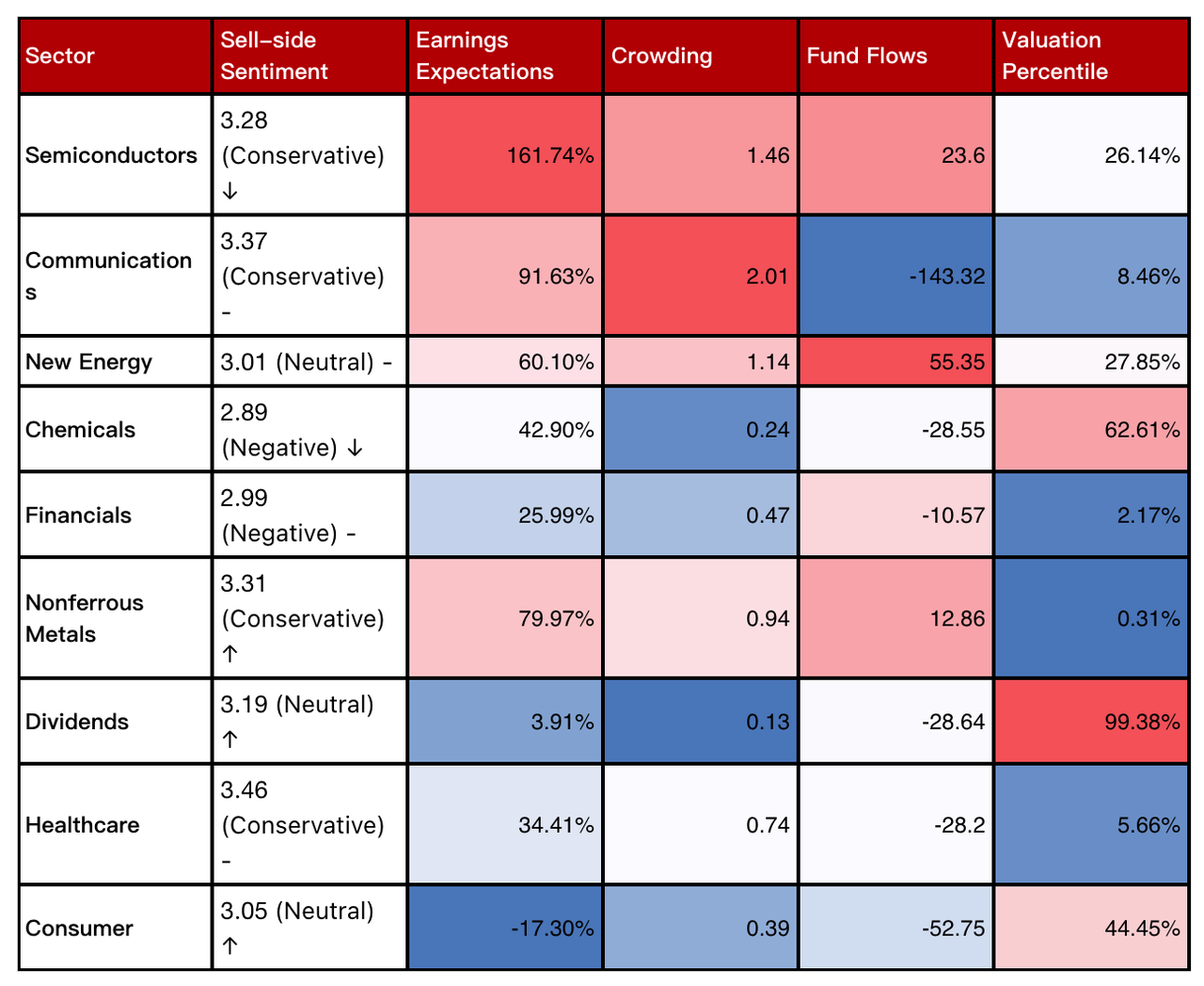
Sector Sentiment & Market Indicators
Methodology & Data Notes
Sell-side sentiment scores are generated using AI-based semantic analysis of at least 20 sell-side weekly research reports for each sector published during the prior week. Scores use a 1–5 scale based on positive and negative keyword frequency: 3.0–3.25 = Neutral; 3.25–3.6 = Conservative; ≥3.6 = Positive; <3.0 = Negative.
Earnings Expectations = (Consensus Net Profit FY1 – Net Profit FY0) / |Net Profit FY0| × 100. Crowding = the sector index’s share of total A-share turnover divided by its share of total A-share free-float market capitalization. Fund Flows represent net main-fund inflows over the most recent week. Valuation Percentile is based on the past five years.
Data as of November 6, 2026. Source: ChinaAMC Research
Disclaimer
Investment involves risk, including possible loss of principal. Any forecasts, projections, or opinions contained herein are for reference only and are not guaranteed to occur. The information in this material reflects prevailing market conditions and our judgment as of the release date, which are subject to change without further notice.

 close
 About ChinaAMC